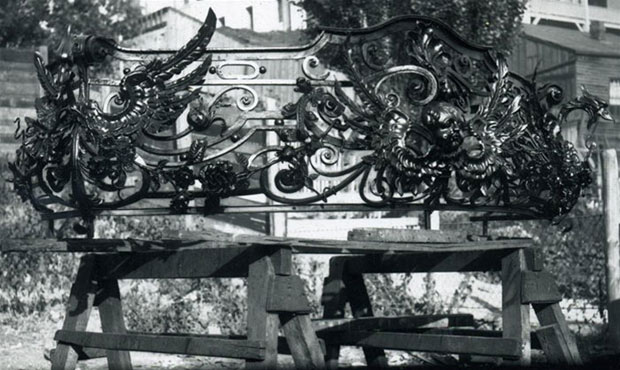
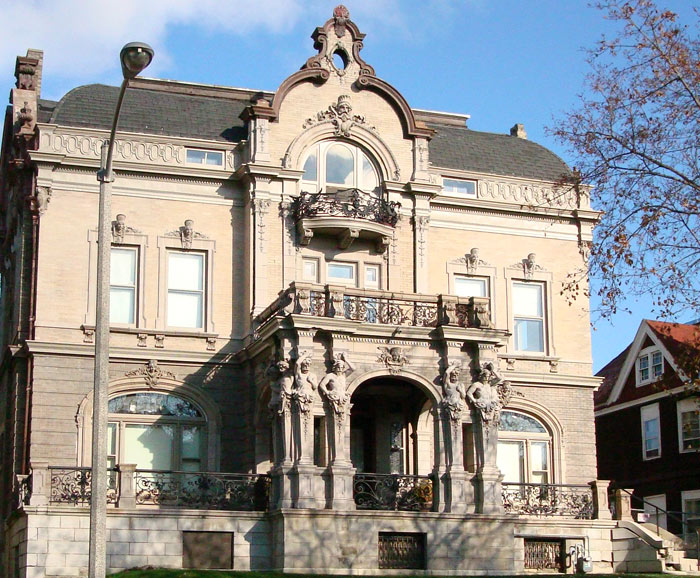
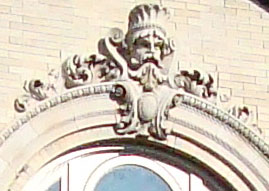
The Front, and Interior of 2432 West Kilbourn Ave has a Greek Mythology them from Poseidon at the Top of the Structure to the balcony with the two Phoenix Birds and the baby infant face. The son of Poseidon and Amphitrite, Triton holds up the front porch coming out from the sea. Amphitrite face is on the left and the right of the new post as you enter to second floor and above the exterior windows. The railing have seahorse on the left and right side. The top balcony (view photo) is considered to be Cyril Colnik's masterpiece done at his studio and installed at the house. The railing is from and the wrought iron interior fixture, fireplace accessories are done by Cyril Colnik.
POSEIDON LORD OF THE SEA
Poseidon is the son KRONOS and RHEIA, brother of ZEUS, HADES, HESTIA, DEMETER and HERA. POSEIDON is one of the six siblings who eventually "divided" the power of the world with his brothers and sisters. He is one of the six original Olympians. He is most famous as the god of the sea. His mission is to give voice to the earth. Poseidon was commonly called the Earth-
Shaker and the Earth Encircler in the Iliad and the Odyssey of Homer. He pounds and shakes the earth and sea with his wrath and pleasure and answers to no one, except Zeus. Poseidon often used his powers of earthquakes , water , and horses to inflict fear an punishment on people as revenge. Though he could be difficult and assert his powers over the gods and mortals, Poseidon could be cooperative and it was he who helped the Greeks during the Trojan War. Poseidon is an essential character in the study of Greek mythology.
His Kingdom is the vast seas which he has populated with creatures of his own design. He rides the wave in a chariot drawn by dolphins but, curiously enough, his most honored creation is the horse.
Poseidon once married a Nereid, Amphitrite ( nymph and ancient sea-goddess), and produced Triton who was half-human and half fish.
MERMEN are mythical male legendary creatures who are human form the waist up and fish-like from the waist down. A merman, like a mermaid, attracts humans with singing and tones. Also said to be wise teachers. The most well known was probably Triton, son of Poseidon and Amphitrite.
Triton is a mythological Greek God, the messenger of the sea. He is the son of Poseidon, god of the sea and Amphitrite, goddess of the sea, whose herald he is. He is usually represented as a merman, having the upper body of a human and the tail of a fish, often depicted with a beard. Usually more violent than mermaids, would cause storms or attack ships.
Like his father., Poseidon, he carried a trident. However, Triton's special attribute was a twisted conch shell, on which he blew like a trumpet to calm or raise the waves. Its sound was so terrible, that when loudly blown, it put the giants to flight, who imagined it to be the roar of a mighty wild beast. Triton dwelt with his parents in a golden place in the depths of the Mediterranean sea.
The Phoenix bird symbolizes immortality, resurrection and life after death. In ancient Greek and Egyptian mythology, it is associated with the sun god. A phoenix is a mythical bird that is a fire sprit with a colorful plumage and a tail of gold and scarlet according to legends.
According the Greeks, the bird lives in Arabia, near a cool well. Every morning at dawn, the sun god would stop his chariot to listen to the bird sing a beautiful song while it bathed in the well.
Only one Phoenix exists at a time. When the bird felt it's death was near, every 550 to 1,461 years life-cycle near the end it would build a nest of aromatic wood twigs and set it on fire. Both nest an dPho0enix burn and was consumed by the flames. From which a new young Phoenix sprang forth from the pyre, born anew to live again. The new Phoenix is destined to live as long as its old self. The new Phoenix embalms the ashes of its predecessor in an egg of myrrh and flew with it and deposits it in the Egyptian city of Heliopolis, (Greek for the city of the sun), where the egg was deposited on the altar of the sun god. It is said that the bird's cry is that of a beautiful song.
THE PHOENIX BIRD
by
Hans Christian Andersen
1850
In the garden of Paradise, beneath the Tree of Knowledge, bloomed a rose bush. Here, in the first rose, a bird was born. His flight was like the flashing of light, his plumage was beauteous, and his song ravishing. But when Eve plucked the fruit of the tree of knowledge of good and evil, when she and Adam were driven from Paradise, there fell from the flaming sword of the cherub a spark into the nest of the bird, which blazed up forthwith. The bird perished in the flames; but from the red egg in the nest there flutters a loft a new the solitary Phoenix bird. The fable tells that he dwells in Arabia, and that every hundred years, he burns himself to death in his nest; but each time a new Phoenix, the only one in the world, rises up from the red egg.
The bird flutters round us, swift as light, beauteous in color, charming in song. When a mother sits by her infants' cradle, he stands on the pillow, and with his wings, forms a glory around the infants head. He flies through the chamber of content, and brings sunshine into it, and the violets on the humble table smell doubly sweet.
But the Phoenix is not the bird of Arabia alone. He wings his way in the glimmer of the Northern Lights over the plains of Lapland, and hops among the yellow flowers in short Greenland summer. Beneath the copper mountains of Fablun, and England's coal mines, he flies, in the shape of dusty moth, over the hymnbook that rests on knees of the pious miner. On a lotus leaf he floats down the scared waters of the Ganges, and the eye of the Hindoo maid gleams bright when she beholds him.
The Phoenix bird, dost thou not know him? The Bird of Paradise, the holy swan of song! On the car of Thespis he sat in the guise of a shattering raven, and flapped his black wings, smeared with the lees of wine; over the sounding harp of Iceland swept the swan's read beak; on Shakespeare's shoulder he sat in the guise of Odin's raven, and whispered in the poets ear "Immortality!" and at the minstrels' feast he fluttered through the halls of the Wartburg.
The Phoenix bird. dost thou not know him? He sang to thee the Marseilles, and thou kissed the pen that fell from his wing; he came in the radiance of Paradise, and perchance thou didst turn away from him towards the sparrow who sat with tinsel on his wings.
The Bird of Paradise- renewed each century in flame, ending in flame! Thy picture in a golden frame, hangs in the halls of the rich, but thou thyself often fliest around lonely and disregarded, myth - "The Phoenix of Arabia".
In paradise, when thou wert born in the first rose, beneath the Tree of Knowledge, thou receivedst a kiss, and thy right name was given thee-thy name, Poetry.
Although descriptions (and life-span) vary, the Phoenix became popular in early Christian art, literature and Christian symbolism, as a symbol of Christ, and further, represented the resurrection, immortality, and the life-after-death of Jesus Christ.
The lines below show the living followers-as symbolized phoenixes-on flight to the beautiful home of the Phoenix (Paradise). In relationship to the Old English Christianity.
"Now just so after death, through the Lord's might, souls together with body will journey-handsomely adorner, just like the bird, with noble perfumes into abundant joys where the sun, steadfastly true, glistens radiant above the multitudes in heavenly city.
Then the redeeming Christ, high above it's roofs, will shine upon souls steadfast in truth. Him they will follow, these beautiful birds, radiantly regenerate, blissfully jubilant, spirits elect into that happy home everlasting to eternity. There the friend, outcast, improtunate, cannot treacherously harm them by his evil, but there they shall live forever clothed in light, gist as the phoenix bird, in the safe keeping of the Lord, radiant in glory. Each one's achievement will brightly spark in that joyous home before the face of the everlasting Lord, perpetually at peace like the sun.
There a bright halo, marvelously braided with precious stones, will rise above the head of each of the blessed. Their head will glisten, crowned with majesty. The rare and regal diadem of a prince will adorn with light each of the righteous in that existence where enduring joy, everlasting and fresh anew, never wanes - but rather they will dwell in beauty, surrounded with glory, with lovely adornments together with the Fathers of the angels."

 The railing have seahorse on the left and right side. The top balcony (